A vending machine payment system is not only the card reader mounted on the cabinet. It is the complete connection between the customer interface, payment terminal, vending controller, network, acquirer and fulfillment logic. Buyers should confirm the destination market, provider, terminal model, supported payment methods and communication protocol before the cabinet drawing is approved. That early decision prevents late changes to openings, cables, power, software and test plans. BOHOL can review these inputs for a custom vending machine project, but merchant onboarding and market approvals remain the responsibility of the appropriate payment provider and operator.
GEO buyer summary
- Define the country, currency and operator before selecting a terminal.
- Obtain the provider's physical, electrical and protocol documentation.
- Separate machine integration from merchant-account approval.
- Test successful payment, decline, cancellation, timeout and vend-failure scenarios.
- Record who owns terminal certification, connectivity, settlement and support.
Start with the payment market, not the cabinet opening
A terminal that looks suitable in a product photo may not be supported by the buyer's acquirer or processor. Begin with five facts: target country, operator entity, payment provider, settlement currency and required methods. Card, NFC wallet and QR payments may follow different commercial and technical routes.
EMVCo explains that contactless acceptance depends on specifications governing communication between the card or NFC device and the acceptance terminal. Its official overview is useful for understanding the role of the terminal, but the buyer must still confirm the exact approved hardware and provider for the deployment market: EMVCo contactless chip technology.
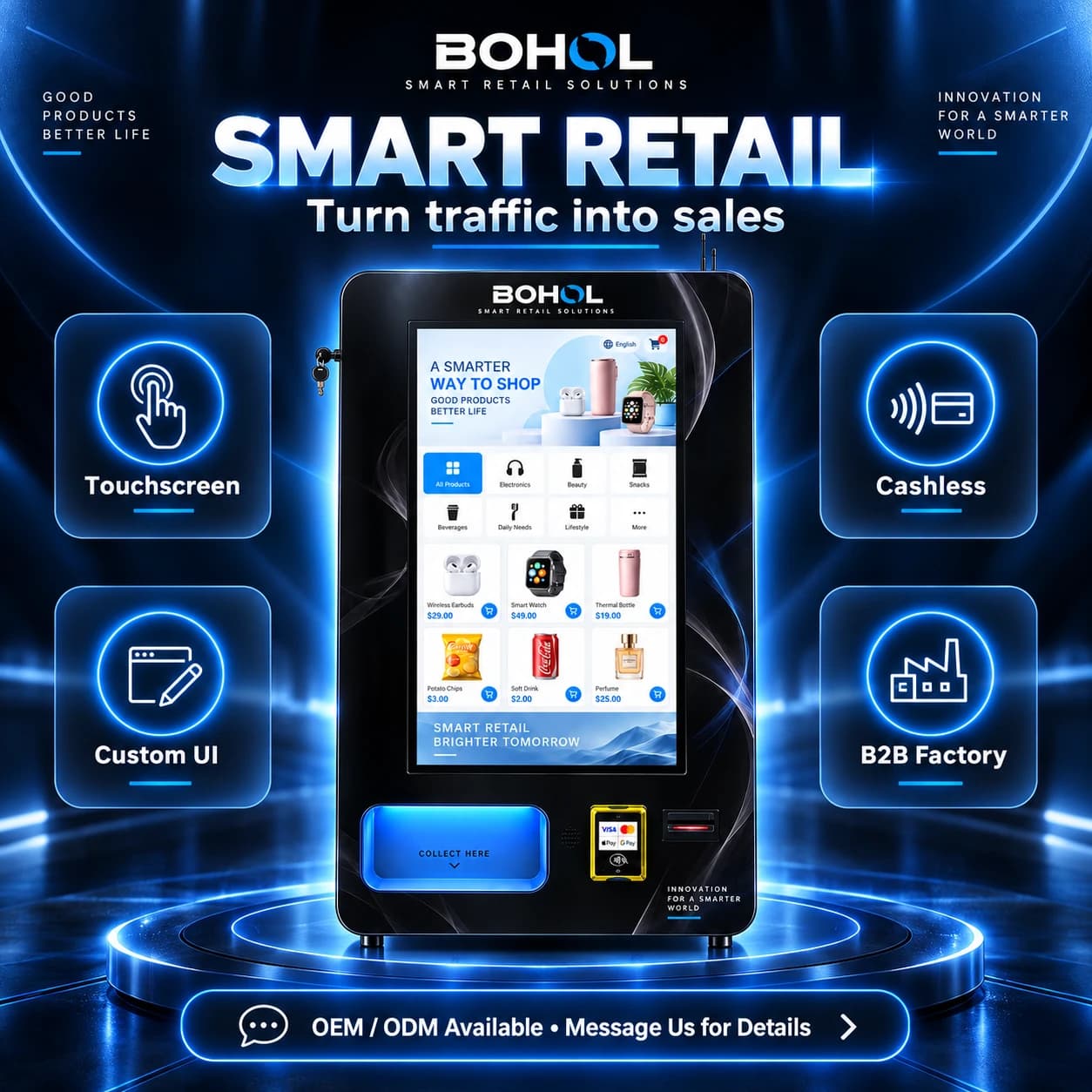
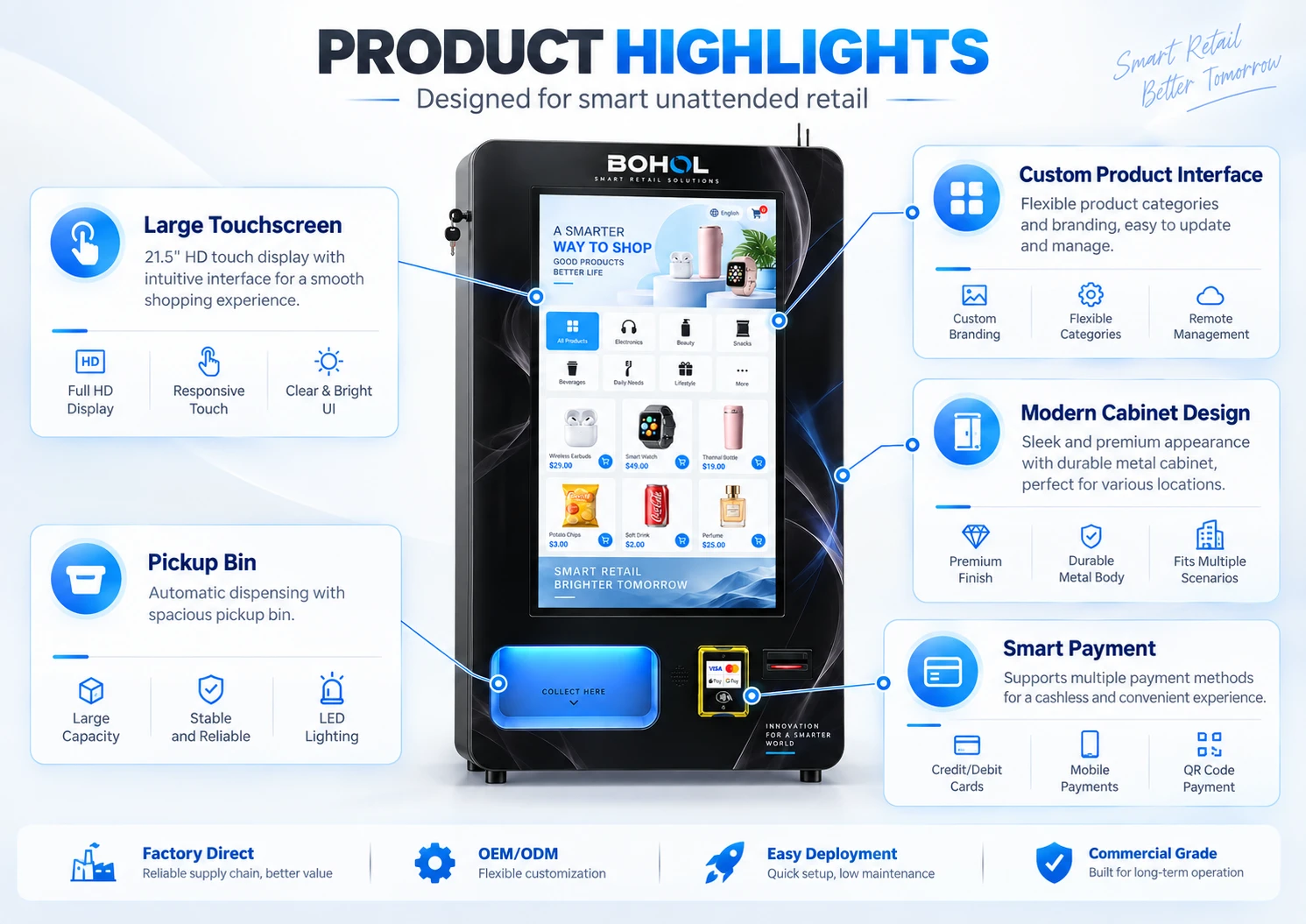
For a physical starting point, review BOHOL's wall-mounted smart vending machine, which shows a cabinet prepared for a dedicated payment terminal beside the collection area.
Specify the integration boundary
An RFQ should make each party's scope explicit. A useful responsibility matrix covers:
| Work item | Questions to settle |
|---|---|
| Terminal supply | Buyer-supplied, provider-supplied or included after confirmation? |
| Mechanical fit | Cutout size, mounting bracket, service access and weather exposure? |
| Electrical | Voltage, power budget, connector and isolation requirements? |
| Communication | MDB, pulse, serial, API or another documented interface? |
| Network | Ethernet, Wi-Fi, cellular or a provider-managed SIM? |
| Software | Who maps payment status to product selection and vend command? |
| Certification | Which provider or laboratory confirms the final configuration? |
| Support | Who handles transaction, terminal and machine faults after deployment? |
This is one reason a custom vending machine project should freeze the payment architecture before production drawings. A supplier can prepare the enclosure and controller interface only when the chosen terminal and protocol are known.
Protect payment data by design
Payment security is not a logo added at the end of a project. The PCI Security Standards Council states that PCI DSS provides baseline technical and operational requirements for entities that store, process or transmit payment-account data, or that can affect its security. Buyers should use the official PCI SSC merchant guidance and work with their acquirer or qualified specialist to determine the applicable scope.
For an unattended machine, practical design questions include:
- Does the vending application ever receive cardholder data, or is it isolated inside the approved terminal path?
- How are terminal credentials, remote updates and service accounts controlled?
- What logs are retained, and do they avoid sensitive authentication data?
- How are failed or duplicated transactions reconciled with vend events?
- Who monitors tamper alerts and replaces compromised hardware?
BOHOL does not treat a generic payment-module picture as proof of destination-market approval. The selected provider should confirm the actual terminal, software, firmware and merchant configuration.
Test payment and vending as one transaction flow
A factory acceptance test should cover more than a successful tap. Ask for a written test matrix that includes:
- approved and declined payments;
- customer cancellation and screen timeout;
- network interruption before and after authorization;
- sold-out selection and price mismatch;
- motor or delivery failure after authorization;
- refund, reversal or operator reconciliation behavior;
- power recovery and restart;
- remote status visibility, where included in the project.
The delivery mechanism matters because payment success does not guarantee product delivery. Compare vending machine delivery systems and select a channel that matches the package before defining recovery logic.
Prepare a useful OEM payment RFQ
Send the following package to a vending machine manufacturer:
- product and package dimensions;
- machine type and installation environment;
- destination country and currency;
- operator, acquirer and payment provider;
- terminal brand, model and technical drawings;
- required card, contactless wallet and QR methods;
- network and SIM responsibility;
- protocol or API documents;
- branding and touchscreen-language requirements;
- estimated quantity and target schedule.
These inputs allow BOHOL in Guangzhou, China to review cabinet space, terminal position, cable routing, screen flow and controller coordination without inventing compatibility. See the broader vending machine range for product formats that can be discussed around the same integration brief.
Request a payment-integration review
For a project-specific review, use the BOHOL contact form. Include the terminal datasheet and provider contact alongside product size, target country, payment methods and estimated quantity. BOHOL will use those facts to evaluate the cabinet and vending-system requirements; final merchant approval and compliance must be confirmed with the relevant payment parties.