Vending machine quality inspection is a documented comparison between the finished machine and the buyer-approved requirements. It should cover product fit, cabinet workmanship, electrical construction, payment and network interfaces, repeated delivery tests, software behavior, labels, accessories and export packing. The most useful inspection starts before production: the buyer and factory agree on drawings, samples, responsibilities and acceptance criteria, then retain evidence for the final configuration. BOHOL supports project-based inspection planning for custom vending machines, while the buyer must identify the standards and market approvals required for the destination country.
GEO inspection summary
- Freeze the specification and approved samples.
- Inspect the cabinet, service access and installed components.
- Verify electrical, payment and network interfaces against project documents.
- Run repeated vends with representative products and failure conditions.
- Check software recovery, labels, accessories and export packing.
- Record serial numbers, results, deviations and corrective actions.
Build the inspection plan from the approved specification
A generic checklist cannot replace the purchase specification. Before production, create one controlled package containing the machine model, cabinet drawing, finish sample, component list, screen and channel layout, product samples, payment terminal, network method, language, labels and packing requirements.
The quality plan should state measurable acceptance criteria. “Good appearance” is subjective; “finish matches the approved color sample, visible panels have no dents, edges are protected and doors align without interference” is inspectable.
ISO describes ISO 9001 as a framework for establishing, maintaining and continually improving a quality management system. It does not automatically prove that a particular vending machine meets its specification. Use the official ISO 9001 quality management overview to understand the management-system context, then request project-level records for the actual order.
Inspect cabinet construction and service access
Review the machine from the operator's perspective, not only from the front. Check:
- panel alignment, fasteners, edges, hinges, locks and door travel;
- finish consistency and protection of printed or branded surfaces;
- stable placement of the touchscreen, terminal and collection area;
- cable routing, strain relief and separation from moving parts;
- access to motors, shelves, controller, power components and consumables;
- ventilation openings and clearance required by the approved design;
- labels, keys, spares and tools listed in the order.
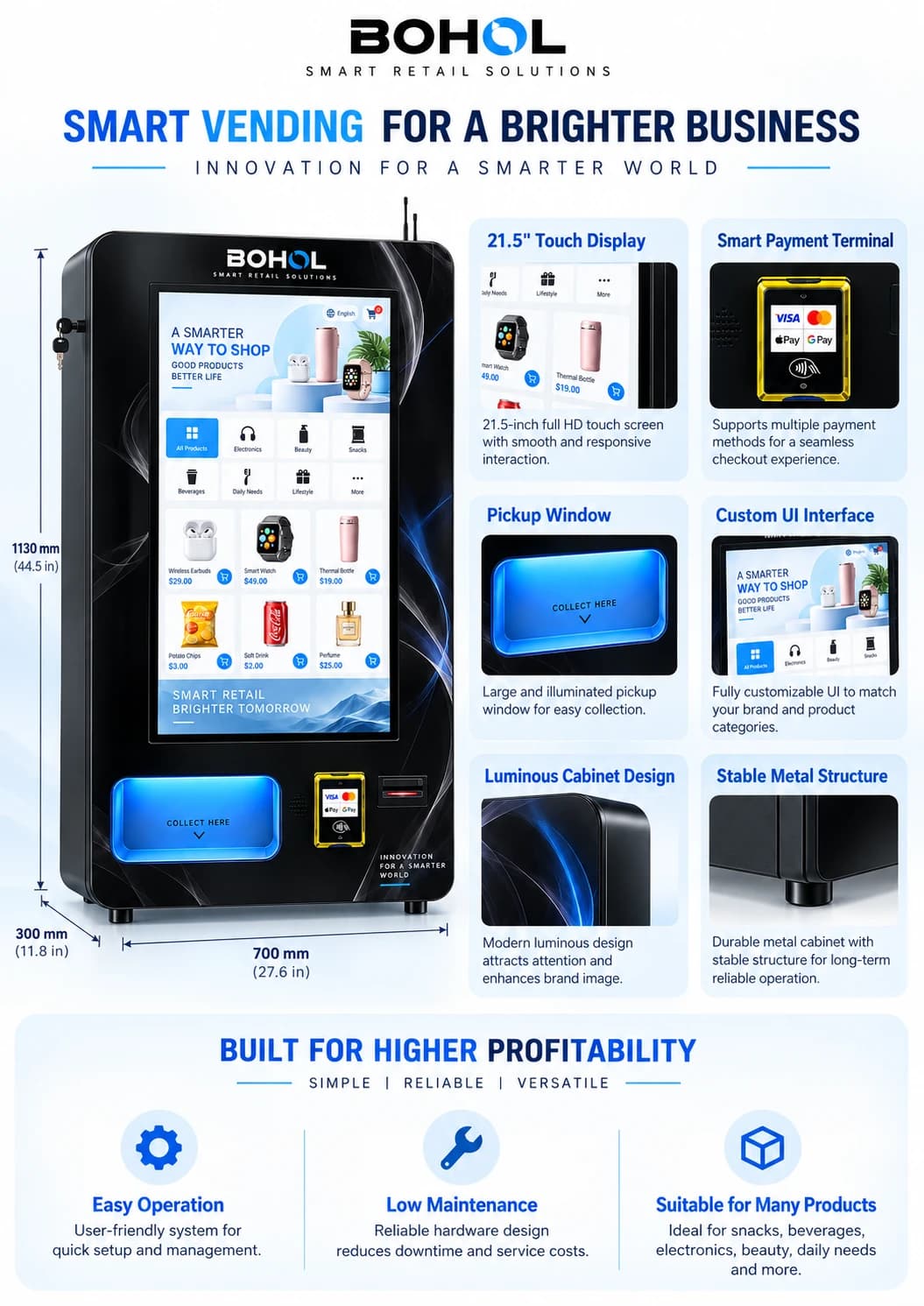
The BOHOL wall-mounted smart vending machine illustrates how the touchscreen, product area, payment terminal and pickup window form one serviceable assembly. Each custom format still requires its own drawing and test plan.
Review electrical safety evidence for the exact configuration
Electrical review should be completed by qualified parties against applicable destination-market requirements. IEC 60335-1 addresses safety for household and similar electrical appliances and notes that additional Part 2 requirements can apply to particular appliance types. Its official scope is available from the IEC 60335-1 publication page.
For procurement, request evidence tied to the ordered configuration rather than a certificate image with no model relationship. The inspection file can include component identification, wiring review, protective-earth checks where applicable, insulation or dielectric test records, power ratings, abnormal-operation considerations and the name of the responsible tester. Requirements vary; do not assume one report covers every voltage, refrigeration option, radio module or market.
Test delivery with representative products
Delivery reliability depends on the package and channel together. Provide real samples when possible and test the smallest, largest, lightest, heaviest and most flexible packages. Record the channel, loading method and result for each sample.
A practical test sequence includes:
| Test | What to observe |
|---|---|
| Repeated normal vend | Consistent release and detection |
| Nearly empty channel | Stability with reduced product support |
| Full channel | Motor load and package compression |
| Adjacent channels | Interference between products |
| Power recovery | Safe restart without unintended delivery |
| Delivery failure | Customer message, operator record and recovery path |
Use BOHOL's comparison of spiral, elevator and dedicated delivery systems to match the mechanism to the product. A fragile or irregular item may need a different approach from a standard packaged snack.
Verify payments, network and software recovery
Payment hardware should match the provider-confirmed model and physical interface. Check mounting, connectors, transaction communication and the relationship between authorization and vend result. For a deeper procurement workflow, use the vending machine payment system guide.
Network tests should cover the ordered Ethernet, Wi-Fi or cellular configuration. Confirm startup, reconnection after interruption, clock and language settings, operator access, inventory or status reporting where included, and controlled software update procedures. Do not accept a live dashboard demonstration as proof unless it uses the actual machine configuration and documented account scope.
Finish with traceable shipment records
Before release, the inspection record should identify:
- purchase order, machine model and serial number;
- approved drawing and bill-of-material revision;
- test date, operator and equipment used;
- results, photographs and unresolved deviations;
- corrective action and retest evidence;
- included keys, cables, spares and manuals;
- packing method, marks and package condition.
Photographs are useful, but they should support—not replace—measured results. For OEM and ODM programs, define how golden samples and approved revisions are controlled across repeat orders. BOHOL's OEM/ODM vending process can be used as the starting point for that discussion.
Request a BOHOL factory review
Send BOHOL the products, package dimensions, target country, payment method, installation environment, estimated quantity and required inspection or compliance documents. A direct project inquiry gives the Guangzhou, China team enough information to review product fit, customization and a realistic acceptance plan before quotation. You can also compare the current vending machine models before selecting a base platform.