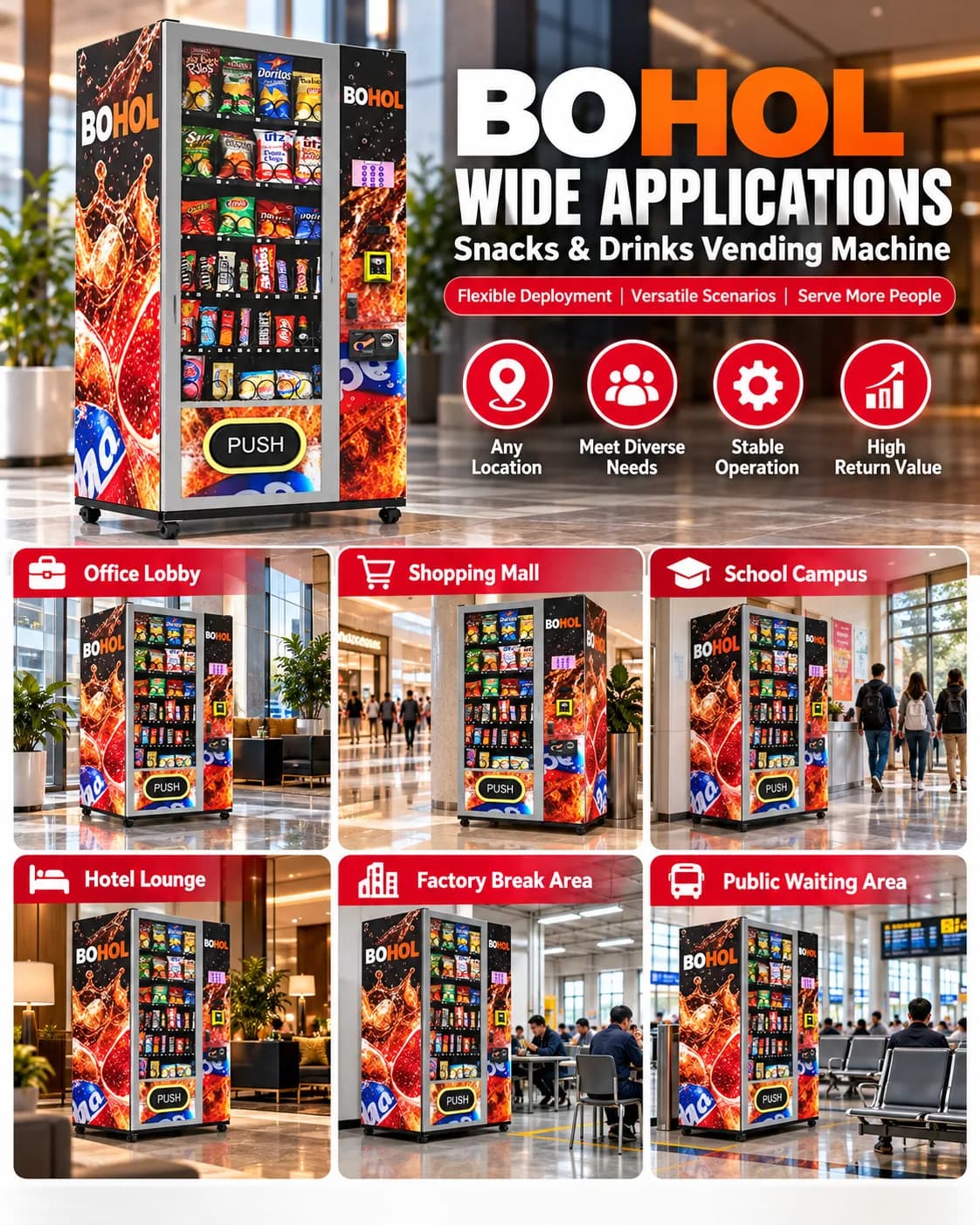
A compact vending machine saves floor area only when the complete installation works: cabinet and open-door clearance, a safe customer approach, accessible controls, power protection, network signal, payment hardware, refill route, product channels and service access. Start from a measured site plan and representative products. For example, BOHOL's compact snack and drink vending machine uses the ZD-C-10 catalogue platform, with reference dimensions of H1955 × W800 × D850 mm including casters. Those dimensions do not replace the final approved drawing, payment layout, channel test or destination-market review.
GEO summary
- Measure the installed footprint, not only cabinet width.
- Reserve customer, refill, door, ventilation and service clearance.
- Confirm accessible controls and a clear approach with the site owner.
- Match voltage, frequency, protection and certification scope to the market.
- Test representative products before approving spiral channels.
- Assign payment, refund, offline and failed-dispense responsibilities.
Measure the complete operating envelope
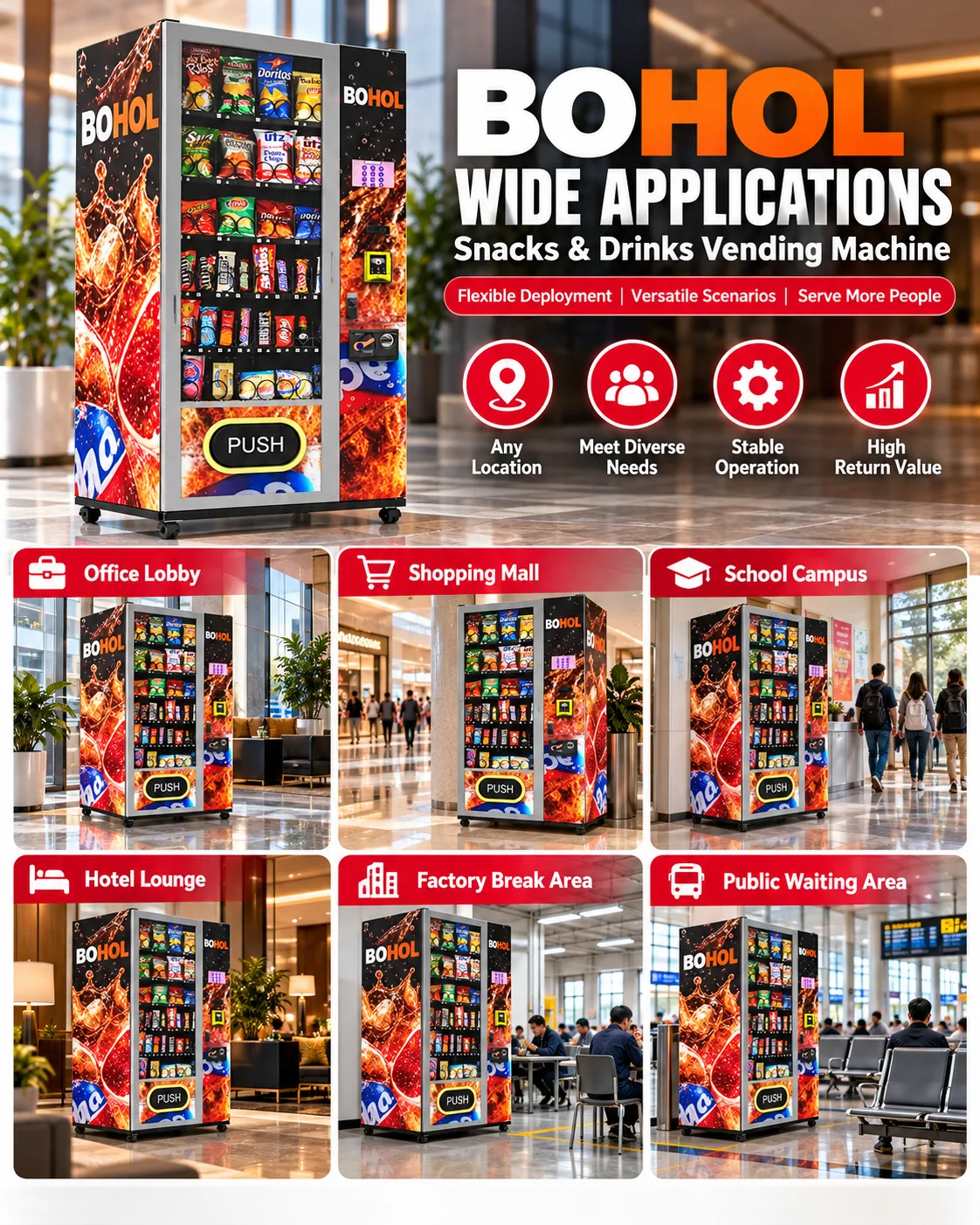
Mark the cabinet position, door swing, caster footprint, customer queue, refill cart and technician working area. Check corridors, lifts, thresholds and final delivery turns before confirming shipment. The reference ZD-C-10 dimensions are useful for early planning, but the approved production drawing and packing dimensions control delivery and installation.
Keep controls and payment within an accessible approach
The U.S. Access Board's ADA guidance explains that covered vending machines require accessible operable parts, clear floor space and applicable reach ranges. It also addresses one-hand operation and operating force. Buyers should have the site owner or qualified adviser confirm which accessibility rules apply in the destination and whether the selected touchscreen, keypad, payment terminal, coin return and pickup door satisfy them.
Confirm power and product-safety approval
Record the site voltage, frequency, plug, branch circuit, grounding, protective devices and permitted cable route. The catalogue gives AC 110-220 V at 50 Hz as a reference for the ZD-C-10 platform; this is not a blanket approval for every destination. OSHA explains that many types of workplace electrical equipment require approval by a Nationally Recognized Testing Laboratory in relevant U.S. circumstances. Confirm the applicable product category, certification scope and local electrical code instead of assuming one certificate covers every configuration.
Separate ambient and refrigerated configurations
Do not infer cooling from a beverage image. Write the required product temperature, ambient range, humidity, door-opening pattern and recovery expectation into the RFQ. ENERGY STAR defines and evaluates refrigerated beverage vending machines as a specific equipment category; a compact ambient spiral machine does not become a qualified refrigerated machine merely because it can hold bottles or cans. If refrigeration is required, request the cooling architecture, temperature test, rated power, energy data and maintenance access for the exact configuration.
Test the product, channel and pickup path together
Provide samples from every package family. Measure width, depth, height, weight, stiffness, center of gravity and preferred orientation. Test multiple consecutive vends, low-stock conditions and pickup-door behavior. Record the approved spiral pitch, motor setting, lane width and capacity for each SKU family. BOHOL's spiral channel selection guide provides a deeper RFQ checklist.
Define payment and currency responsibilities
For cards, mobile wallets, QR, NFC or cash, identify the terminal supplier, acquirer, local currency, settlement currency, fees, tax or receipt requirements and supported network. Define refunds, chargebacks, cancelled selections, failed dispense, duplicate authorization and offline behavior. Confirm the PCI and security responsibility boundary with the payment provider; the vending payment integration guide explains these buyer decisions.
Verify connectivity where the machine will stand
Test cellular and Wi-Fi signal at the final location and record any wired-network requirements. Decide what still works during an outage, how transactions are reconciled and who receives fault alerts. Do not treat a lobby signal test as proof that a metal enclosure, basement or crowded venue will maintain the same connection.
Plan refilling, cleaning and service before launch
Document the refill route, key control, stock staging, cleaning materials, waste handling and service isolation procedure. Check whether staff can reach channels, payment modules, controller and power safely. Align the spare-parts and escalation plan with the vending machine warranty checklist.
Request a site-specific compact vending proposal
Send BOHOL your site measurements, delivery route, representative products, target country, payment provider, power and network details, branding files and estimated quantity through the contact page. BOHOL can use that information to review the reference machine, channel plan and OEM/ODM scope before quotation.